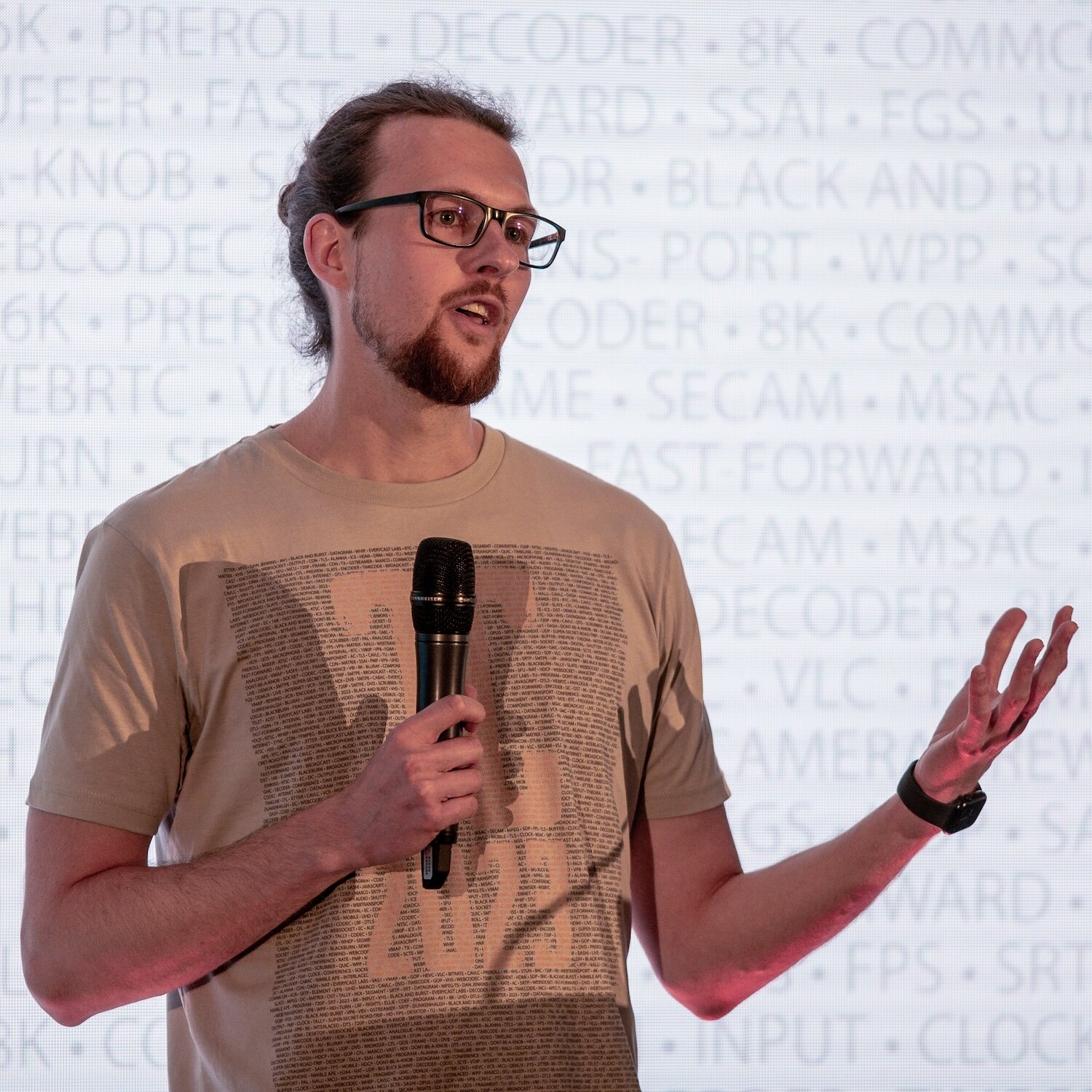
Demuxed has always been a place where the video engineering community gathers to share progress, challenges, and ideas. Once again, it delivered content from different points of view in the video industry and we came back inspired.
Here are some of our favourite talks from Demuxed London 2025.
Performant and accessible client-side media processing with Mediabunny, by David Payr
We are very excited about this one! Mediabunny is a toolkit built around WebCodecs that makes it easier to manipulate video directly in the browser. It’s already being used by projects like Remotion for in-browser video conversion and Pikimov for browser-based video editing.
This talk highlighted how accessible advanced video manipulation in the browser has become, and how it opens up creative and technical possibilities for future tools. We can’t wait to start experimenting with it!
MoQ: Not Another Tech Demo, by Luke Curley
Luke’s talk on MoQ explored how QUIC is emerging as the foundation for scalable, low-latency video distribution. MoQ shows great promise especially for live content distribution at scale with sub-second latency, and for anything that sits at the intersection between video calls and traditional video streaming.
In fact, MoQ shouldn’t really be thought of as a replacement for either VOD or WebRTC, which is still the optimal solution for use cases like Google Meet. But when an application needs flexibility and scale, MoQ is worth exploring, even if it means having to solve problems that have already been solved by other technologies.
Reinventing Video.js for the Next 15 Years, by Steve Heffernan
Steve presented the complete rebuild of the Video.js player for version 10. The new version moves away from the old monolithic structure, offering a much more modular approach. You can now use only the UI, only the core player, or build your own layers on top. It’s a significant improvement for developers who want flexibility without sacrificing stability.
FFmpeg's starring role at the BFI National Archive, by Joanna White
This talk offered a fascinating look behind the scenes at the BFI National Archive. The Archive’s focus is on using technologies that are open, sustainable, and future-proof, which is crucial when working with materials that degrade over time, such as magnetic tapes. This is evidenced even in their choice of codecs, for example: The archive uses FFV1, an open-source format that can handle a wide range of sources.
It was a great reminder of how technical choices can have long-term cultural and historical impact.
Streaming Video on 80's Gaming Hardware, by Joey Parrish
Joey took us on a walk through memory lane, showcasing how he was able to build a video streaming platform on the Sega Mega Drive! He set the tone for the talk beautifully by walking on stage and plugging the console into the venue’s AV system, to play his slides from a cartridge. After a deep dive into hardware and codec specs, he ejected the slides cartridge, inserted his modified prototype (powered by a Raspberry Pi) and entertained the audience with a 9-bit rendition of Video Killed The Radio Star!
All VOD content is available on the Demuxed 2025 website now for $25, until it becomes readily available on YouTube.
Conclusion
We left feeling inspired by how much experimentation is happening around WebCodecs and browser-based media tools. Seeing so many creative uses of these technologies, from preservation to real-time video editing, made us eager to start experimenting ourselves.
It was fantastic to see Demuxed come to Europe, and the London edition lived up to every expectation. We can’t wait to start testing some of the ideas we discovered and we’re already looking forward to the San Francisco edition next year.
Need help?
Nimble Ape has been consulting on real-time media projects for over a decade. We build products, for clients big and small all over the globe. If you’re working on these technologies and need some extra support, we’re happy to help.
Why not drop us a line on [email protected].
- Marco, Dan, and the Nimble Ape team